CNC carbide grind
Use when fit, stiffness, and Ra must resemble the production tool on the 0.500 in hydraulic land. Tolerance can approach ±0.025 mm on critical lands if the print allows the time and cost.
FREE sourcing support for qualified business buyers, with an eligible benefit of up to 3%. Eligibility applies to qualified business buyers and is confirmed after we review your product, quantity, destination, and sourcing requirements.
Hardware teams often mix CNC carbide, SLA form checks, SLS fixtures, and MJF holders in one week while a hydraulic-block shop tries a 0.500 in land. This page is an iteration playbook for comparing carbide reamer manufacturers on process, not a claim that this desk owns a 72-hour machine cell.
Use when fit, stiffness, and Ra must resemble the production tool on the 0.500 in hydraulic land. Tolerance can approach ±0.025 mm on critical lands if the print allows the time and cost.
Useful for holder clearance and hand-feel of a chucking reamer versus a floating holder. It does not prove carbide edge life or hardness HRC. Keep it off the production RFQ unless clearly marked as a mock-up.
Nylon fixtures help try a shank interface on the hydraulic-block machine. Layer height and anisotropy are limits; do not treat the fixture as a cutting tool.
Faster polymer holders for layout reviews. Confirm if dimensional reports are even needed; many teams only need envelope checks before the first carbide grind.
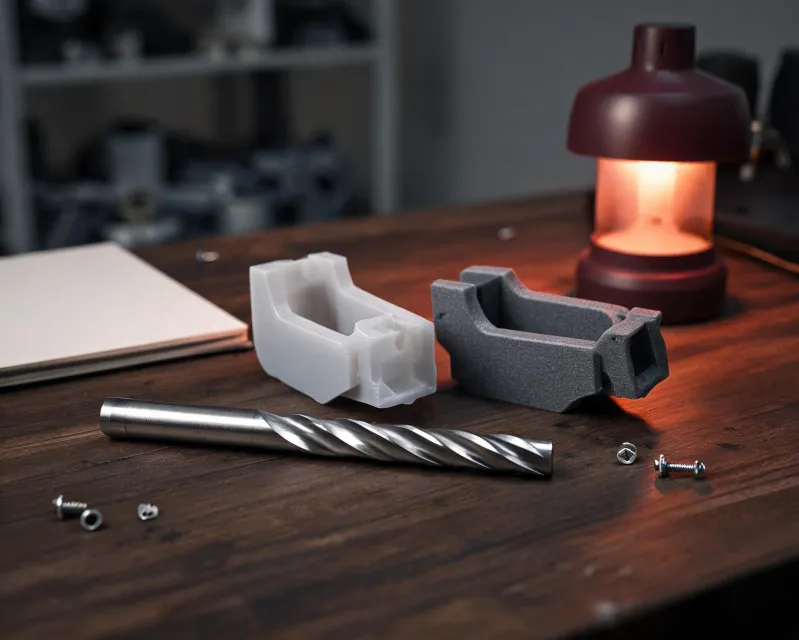
A polymer print cannot stand in for carbide or PCD on a cutting trial of a 0.500 in hydraulic land. If a factory offers HSS instead of carbide, write the hardness HRC and wear expectation on the same line as price.
A 72-hour narrative is a planning target, not a promise from this site. Ask which operations are skipped: coating, FAI, cylindricity after ream, or cryogenic treat.
Prototype grind lots and production heat-treat lots can diverge. Request the change-control rule, including holder type, before the first production PO.
Owning an FDM/SLA cell helps daily iteration. A bureau may still be needed for SLS, MJF, or DMLS without capital spend. Neither path is this desk’s factory.
| Choice | Prototype implication | Production implication |
|---|---|---|
| Flute count | Can be printed as a dummy | Must be ground and balanced |
| Floating holder or rigid chuck on this bore? | Check spindle alignment with an SLA or MJF holder mock-up | Lock chucking reamer versus floating holder before coating |
| Edge hone | Often skipped on first metal | Must be specified if wear is measured |
| Choice | When it is enough | When it is not |
|---|---|---|
| Carbide blank | Fit/function and first chips on a 0.500 in land | Long aluminum runs that need PCD |
| HSS | Soft trial materials | Abrasive composites |
| Polymer print | Envelope and assembly | Any cutting trial or cylindricity after ream proof |
| Method | Ask for | Limitation |
|---|---|---|
| CMM | Report format, datums, and cylindricity after ream | Does not prove edge toughness |
| FAI | Which 0.500 in characteristics are ballooned | One piece is not Cpk |
| Optical | Edge photos after first chips | Subjective unless a scale is agreed |
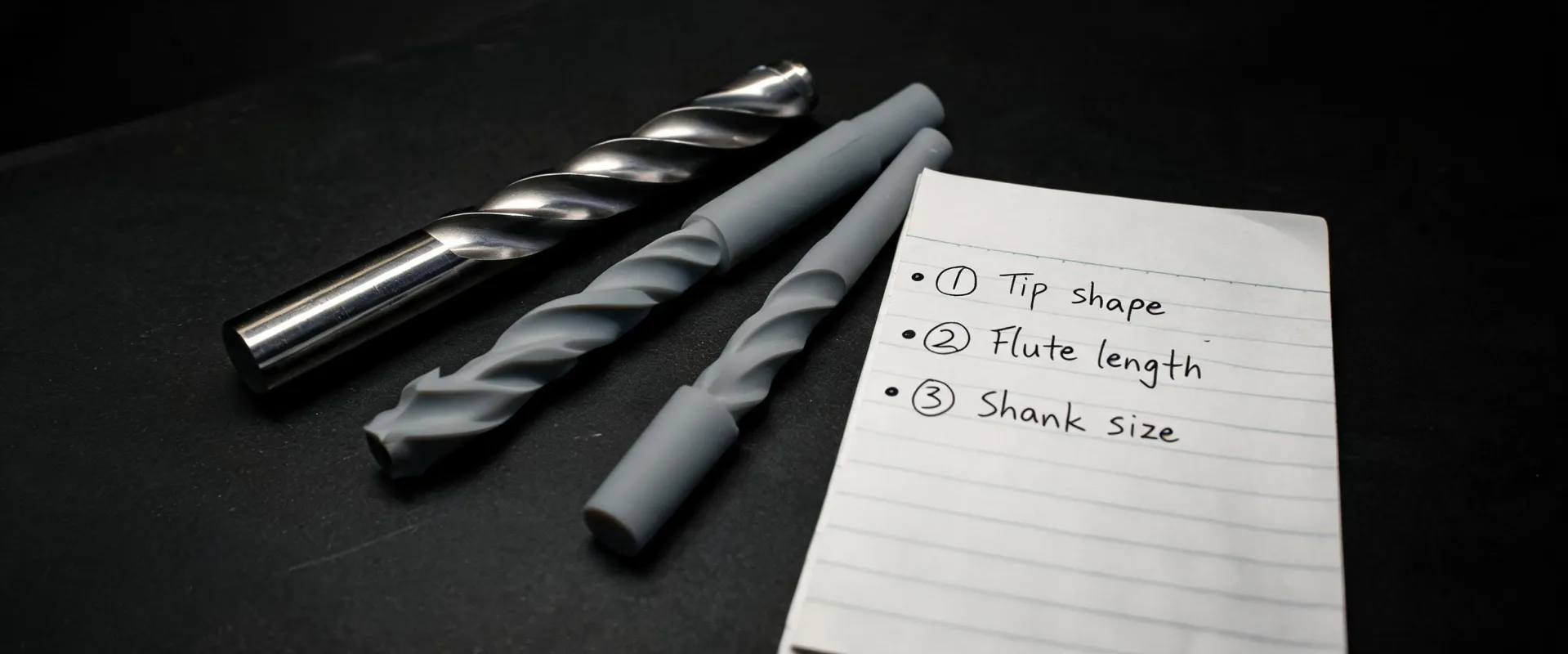
Tell us which 0.500 in lands are frozen and which alternatives a factory may propose. We will ask carbide reamer manufacturers to quote that same remainder.