Reamer Manufacturer Sourcing: A Buyer's FAQ (From Someone Who Got It Wrong First)
2026-11-12
FREE sourcing support for qualified business buyers, with an eligible benefit of up to 3%. Eligibility applies to qualified business buyers and is confirmed after we review your product, quantity, destination, and sourcing requirements.
Procurement brief
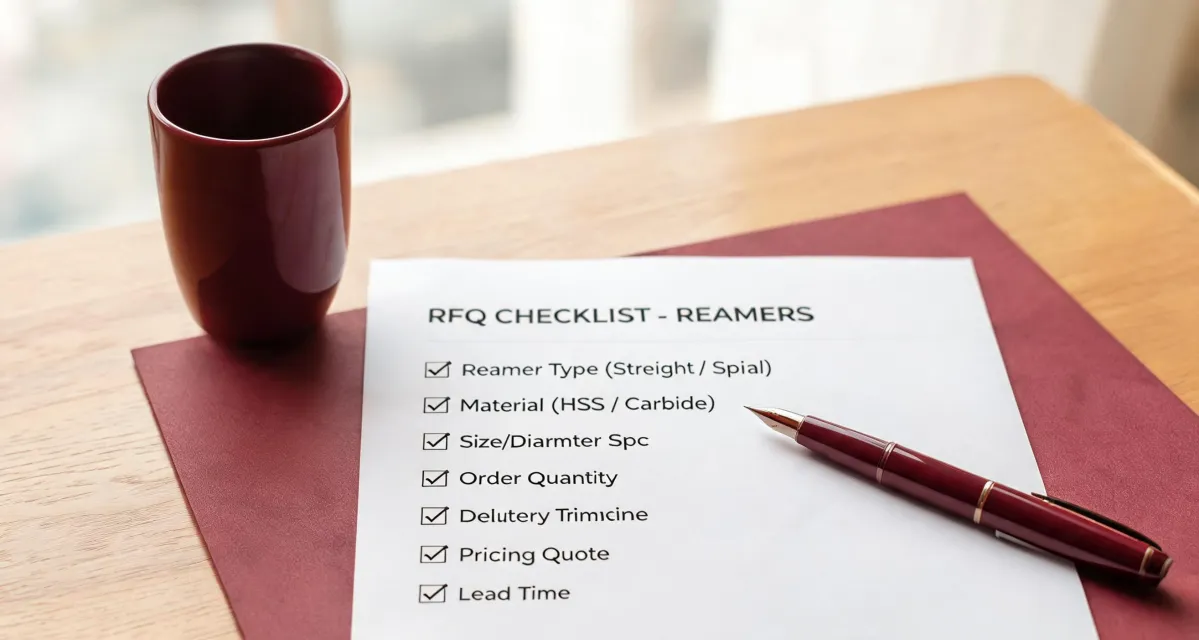
Look, I'm not a machinist. I'm the person who signs off on tooling orders and gets blamed when production stops. Over the past four years at a 140-person precision shop, I've placed roughly 260 reamer orders—standard carbide, the occasional PCD, and a handful of custom acetabular parts for our medical-adjacent line. (Yes, that last category comes with its own documentation headaches.)
I'm writing this because every "how to choose a reamer manufacturer" guide I've read assumes you have an engineering degree. I don't. I'm an office administrator who manages around $780K a year in tooling and consumables across 16 vendors. Here's what I actually check before I sign off—and where I'll honestly tell you to look somewhere else.
Ask for a sample inspection report—not a catalog. The catalog tells you what they can quote; the inspection report tells you what they can actually hold. Most buyers focus on unit price and completely miss the inspection documentation format, and that's usually where the gap between two "similar" suppliers shows up. When I took over purchasing in 2022, I picked a supplier based on price alone. Their first batch of "certified" parts arrived with a handwritten sheet claiming measurements that didn't match our bench check. Finance rejected the expense, and I spent three weeks getting a credit note. Now I ask one question before anything else: "Can you send me a sample inspection report from a job you ran last month?" If they hesitate, that's my answer—and I move on.
Honestly? Ask your engineering lead, not the sales rep. Here's the short version I've picked up: carbide is the default for most steel and general machining work. PCD is for non-ferrous materials, composites, or situations where you're burning through carbide faster than you'd like. From the outside, PCD looks like the premium upgrade. The reality is that PCD is less forgiving on impact and can fail hard on the wrong substrate. I almost ordered PCD for a cast iron job in 2024 because the quote was only 30% higher—our machinist caught it two hours before I hit send. Dodged a bullet there. The flip side: if you're running aluminum or composites at volume, standard carbide reamer manufacturers may not be the right conversation. A PCD reamer manufacturer will usually give you a better cost-per-part, even with the higher sticker price.
Because "the same reamer" isn't the same quote. Check what's bundled: setup, first-article inspection, material certification, shipping, and—this one bites procurement teams—the cost of a re-quote if your drawing changes by even a few thousandths. Last fall (October 2025), we collected five quotes on a custom reamer we'd already spec'd. The low one at $410 excluded the inspection documentation our end customer required. The high one at $1,180 included a full dimensional report, material certs, and a first-article inspection signed off by QA. Line by line, they weren't selling the same product. I've also seen "low" quotes that quietly assumed a 6-week lead time while the higher one was 3 weeks—and we needed the 3-week one to avoid a line shutdown.
Depends on volume and internal bandwidth. If you're placing 5–10 custom reamer orders a year, a sourcing agent who already has vetted relationships can save you weeks of calls, factory visits, and translation headaches—especially with overseas acetabular or PCD reamer suppliers. If you're at 50+ orders, direct usually pays off in price and response time. The honest limitation: agents add margin, and not every agent adds enough value to justify it. Ask which factories they've visited in person—not just emailed. If the answer is a list of email addresses, you're paying for introductions, not expertise. I recommend the agent route for low-volume technical buyers, but if you have a dedicated procurement team and a stable supplier list, the math usually shifts toward going direct.
They assume "medical experience" on a website counts as evidence. Most buyers focus on the ISO 13485 logo and completely miss whether the supplier can trace material lots back to the mill. For acetabular reamers specifically, you want material certs with heat-lot traceability, a written inspection plan, and a certificate of conformance—not just a claim of FDA registration. In 2024 a supplier sent us beautiful brochures and then needed two full weeks to produce a single material cert for a trial order. So glad I ran the trial before committing to an annual contract. If you're sourcing for orthopedic use, ask one last thing:
"What do you do when a lot fails incoming inspection?" If the answer is vague, that's a red flag—not a technical detail.
Minimum: drawing with tolerances, material cert, first-article inspection report, and a lead-time commitment in writing (not "typically 4 weeks"). For medical-adjacent parts, add lot traceability and a certificate of conformance. The non-negotiable for me is the inspection report—if a supplier can't show you how they measure, the price is irrelevant. I also ask for a named quality contact, not just a sales email, because when something goes wrong at 4 p.m. on a Friday, that difference really matters.
If your annual volume is under about 20 pieces and your tolerance isn't meaningfully tighter than a standard catalog spec, custom is usually overkill. Standard carbide reamers ship in days for a fraction of the cost. Custom means tooling, first-article approval, and a lead time measured in weeks—before you even factor in the cost of engineering time on your side. I recommend custom for high-volume production or genuinely non-standard geometry. But if you're experimenting or prototyping, start with a standard tool and prove the process first. Buying custom on a hunch is how you end up with a $3,000 reamer sitting in a drawer while a $180 catalog part does the job just fine.
Comments are moderated. Do not send drawings here; use the RFQ form.