Reamer Manufacturer Sourcing: A Buyer's FAQ (From Someone Who Got It Wrong First)
2026-11-12
FREE sourcing support for qualified business buyers, with an eligible benefit of up to 3%. Eligibility applies to qualified business buyers and is confirmed after we review your product, quantity, destination, and sourcing requirements.
Procurement brief
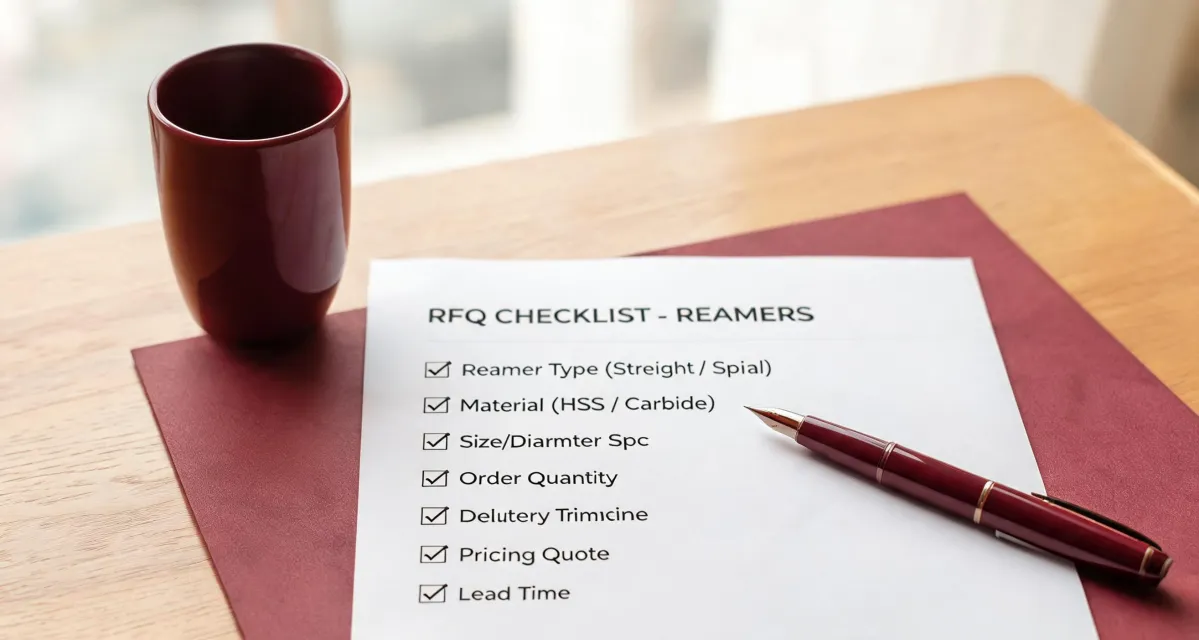
I lost $8,400 and about eight weeks of a customer's patience on my first serious reamer order. Not because the reamers were bad — they were fine. Because I never asked the right questions before the purchase order went out.
Below are the seven questions I get asked most often, with the answers I wish someone had handed me in 2019. No warm-up paragraph. Straight in.
Sourcing means you're hunting for a manufacturing plant, not buying a catalog part. A sourcing service or an internal procurement desk matches you to a factory whose machine tools, material access, and inspection capability genuinely fit your part — not just your RFQ — and then you manage that relationship yourself.
Worth doing when: custom geometry, mixed materials, small batches, or a project where carbide and PCD need to be validated side by side. Not worth doing when: you need a standard 1/2" HSS reamer that runs $40 off the shelf. Hiring a sourcing network to buy a catalog item is like hiring a surveyor to hang a picture.
The catch is that sourcing is only as good as the audits behind it. "We have partner factories in China, Taiwan, and India" is a nice sentence for a website and tells you nothing. Ask when they last walked the floor and what the report said. If they can't name three specific machine models, they're brokering inquiries. That's exactly how I got burned in my first year — and it's why a curated network like Reamer Manufacturer Sourcing, where the factory list already went through an engineering review, tends to cost less than learning the lesson yourself.
Every company claims to be a factory. Most aren't. Four signals flush them out fast — an afternoon of checking, which saves you weeks.
I got caught on signal two in March 2021. Small loss — $1,600 and three weeks of back-and-forth — but the lesson stays on my list.
Most people overthink "custom." For the bulk of non-critical reaming, catalog tooling is enough. You spend custom money when any of these is true:
On cost structure, my experience puts custom reamers roughly 20–40% above catalog pricing — but the tool isn't the expensive part. Validation is. First-article inspection, trial cuts, approval cycles. I ran a price comparison with one supplier: same reamer, same line item, custom quote at $89, catalog at $62. The certification work behind that $89 was another $1,900 the project budget never accounted for.
Flip side: if the print is achievable straight from a catalog, don't let anyone talk you into going custom. I've watched a client spend six or seven thousand extra to get something that was sitting on a shelf.
It comes down to what you're cutting, not what a supplier wants to sell you.
Under the ISO 513:2012 classification, carbide (K-series for non-ferrous, M-series for stainless and high-temp alloys) is the general-purpose workhorse. Tough, regrindable, short lead times, widely available. If your workpiece is steel, stainless, cast iron, or ordinary non-ferrous metal, carbide is the answer.
PCD — polycrystalline diamond — makes sense where edge wear resistance dictates tool life: high-silicon aluminum, CFRP, certain composites, and finishing passes at high speed and feed. Diamond edges outlast carbide by a wide margin, but they're more brittle, regrinding requires specialist equipment, and the bar stock is more expensive.
The comparison that settled it for me: on a 2023 composite drilling job, we ran both side by side. Carbide started showing flank wear around hole 400. PCD was still clean at 1,100. But PCD cost roughly double, and only one validated supplier could regrind it without locking us into a single source. For a 200-hole batch, carbide was obviously right. The material dictates the choice.
Acetabular reamers sit in medical territory. That changes what you ask. Generic industrial reamer questions don't map cleanly onto orthopedic instruments.
My worst lesson here: a supplier passed ISO 9001 and the certificate scope didn't mention medical devices at all. Sixteen acetabular reamers, inconsistent edge prep, all sent back for rework. $2,300 and a very uncomfortable call.
I went back through three years of failed orders and tagged each one. A pattern emerged, and it's the same handful of failures over and over.
Over the last 18 months this list has caught 47 potential errors before shipment. Most were small. Two or three would have been an entire scrapped batch.
"By what method is this dimension being measured — and has the measurement system been through a Gage R&R?"
I never asked it. Every reamer in that shipment arrived with an inspection report reading "pass." On week three of a twelve-week qualification, the customer's quality team re-checked the lot on a CMM and rejected it. The tools weren't wrong. Both sides had measured the same specification with equipment and methods that behaved differently, and neither method made it into the drawing. Nobody lied. The specification just never said which measuring system governed the dimension.
Requalification burned a week. Rework cost $3,200. The real bill was a new customer's confidence, and that one doesn't recover on a redo.
If I had to trade every hinge point I know about reamers for the one question — method and measurement system, in writing, agreed by both sides before manufacturing starts — I'd make that trade without hesitating. The hard part isn't remembering to ask it. It's remembering to ask it on every single RFQ, including the one you're sure is routine.
Comments are moderated. Do not send drawings here; use the RFQ form.